Already available
- Knowledge and content
- Educators
- A desire to work together

Ways to complement one another
We understand the need together and agree responsibilities and compensation before work starts. Human dignity, personal agency and care for nature guide the process.
You may want to learn something, meet an everyday need, or bring an idea to life. Someone else’s knowledge, skill, or resources could help you; what you can offer could be just what another person needs. At BenBiz, we begin by hearing the need as it is and talking about what we can offer one another. Sometimes a conversation or an exchange, a product or a service, or a piece of work we take on together could help meet that need.
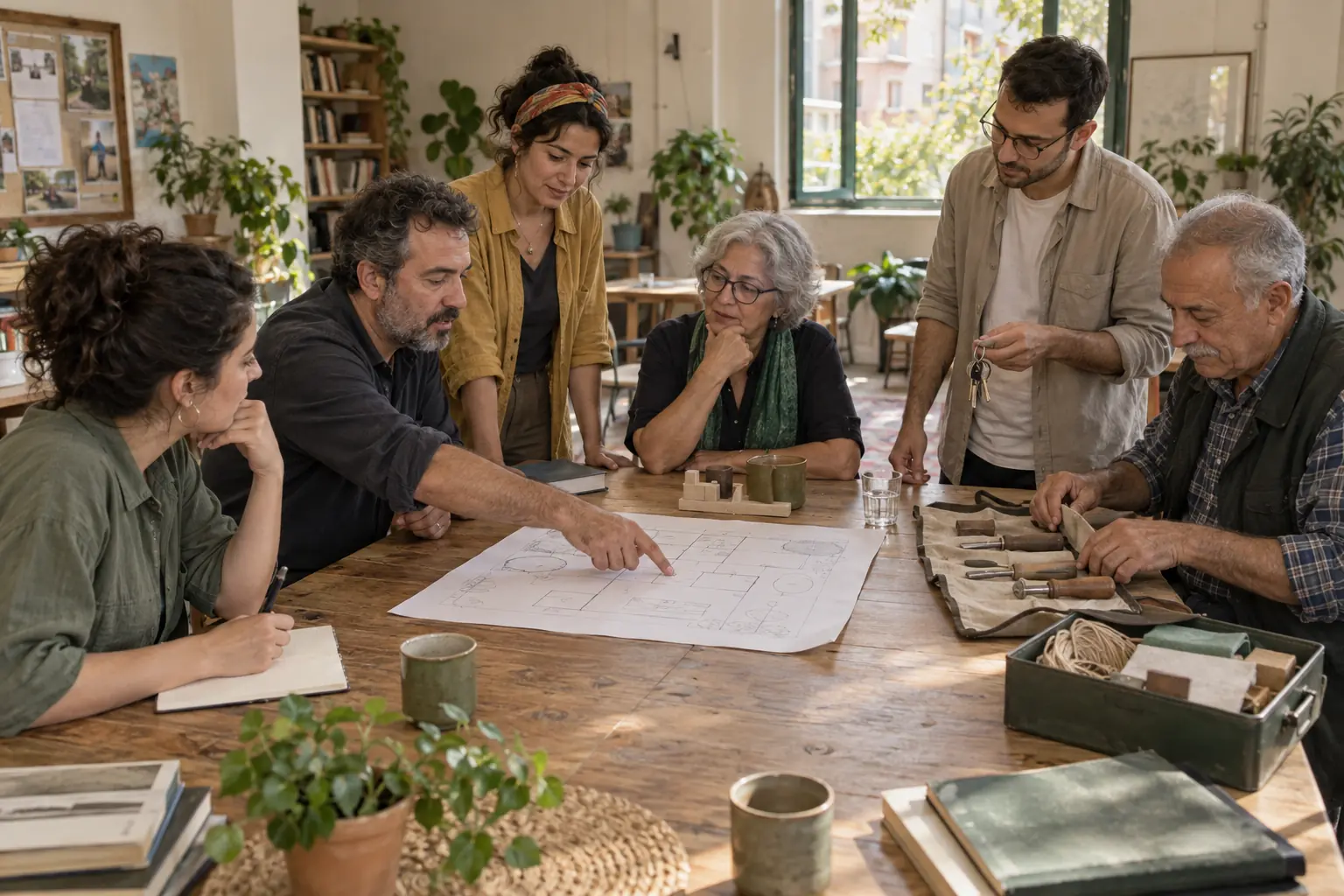
We call small groups that come together to address a shared need and share responsibilities Solidarity Circles.
One person may offer knowledge, another their work, and another a resource they have. Together, we discuss what each person can take on and the terms of those contributions.
The first question
When we want to start a piece of work, we first look at what we need. What do we already have? What is missing? What do we need to clarify before starting? Other people may be able to offer the knowledge, materials, or space we need. Together, we discuss what we need to buy, what we can offer one another, and on what terms.
Imagine we want to organise a course. The educator and content may be ready, while the venue, date, and way to reach participants are still to be agreed. Looking at these parts together makes it easier to see what we need to arrange before starting and how each person could help.
Three phases · six steps
When we begin a piece of work together, each of us may have different amounts of time, resources, and needs. We share these first and discuss what we can do and how. We start small; when conditions change or we learn something new, we revisit our agreements together.
We take time to listen to one another and understand the need.
You do not need to bring a finished project. We try to understand what you want to create or resolve, who it concerns and where we could begin.
We share our knowledge, work, the time we can give, and the resources we have. This helps us see together what is already available and what we need to arrange before starting.
Each of us may have different amounts of time to give, responsibilities we can take on, and needs of our own. Before starting, we share these and consider what the work requires alongside the resources we have.
Who can give their time? Where can we work? What permissions and safety measures do we need? What are the costs? Can we sustain this work? Not every idea needs to become a circle straight away.
We discuss what we want to do, who will take on which tasks, and how long this first period of work will last. Together, we clarify who can make which decisions, within what limits, how expenses will be covered, and what contributors expect in return. We also agree in advance how to protect personal information and what to do if conditions change.
A promise, completed work and the next decision remain distinct; what we learn informs the next step.
Everyone knows what they have taken on. We keep the necessary records without confusing a promise with completed work, and we do not expose personal information to everyone.
What was done, and what proved useful? What have we received as agreed, and what is still unresolved? Is there an objection we need to address? Together we decide whether to continue, change direction or bring the work to a close.
Contribution and return
One of us may volunteer a few hours, another may expect to be paid for their work, and another may ask to have their material costs covered. We can contribute to the same work on different terms. Before starting, we clarify together who will offer what, and on what terms.

How much work, time and responsibility were actually carried?
What uncertainty and burden were genuinely carried at the time?
How fully did the contribution meet the shared need?
How did it support the care, follow-through and continuation of the work?
Exchange and shared work
Offer a product, service or space and discuss terms with people who can help meet your need. Sometimes two people agree on an exchange; sometimes different contributions make a circle’s shared work possible.
You can photograph products, and a maker needs that support. They could offer a product or use of a workspace in return. You agree together on the work, the return and delivery.
For a course, one person could provide a venue, another could teach and someone else could help prepare. A coordinator can start an Exchange listing from an open circle need and track linked listings. Shared costs and distribution terms are discussed separately.
These illustrative examples explain the process; they are not completed agreements.
Prepare a need or contribution listing and select its category. Make clear whether support is voluntary or a return is expected.
In the community area, find members with open contribution or need listings by category, then open a listing from their profile.
Before accepting, clarify scope, timing and any money difference. Once every delivery is confirmed, the completed exchange appears in contribution references; your own contribution details are visible in your profile.
An Exchange agreement is between two people. A circle agrees its shared distribution terms separately. Voluntary support creates no debt; monetary contributions are neither collected nor verified as paid here.
Listings and offers use your existing BenBiz account with a verified email address.
While the work continues
As we carry out the work, we may face different decisions. Some can be made by the person who has taken on the work; others need to be discussed again with those affected. Matters concerning a circle or the whole community are handled through our shared decision process.
The person who has taken on the work makes day-to-day decisions and carries it forward within the boundaries we agreed together.
If the time, responsibilities, costs or expected return are going to change, we discuss them again and reach an agreement with those affected.
Within the community concerned, we discuss the proposal, share our views and vote. Shared Decisions begins with thresholds of at least 60% participation and approval from at least 60% of all votes cast.
From a promise to completed work
We consider the promise we made, the work we completed, the return we agreed on and the payment or delivery that took place as separate stages. Each stage is confirmed separately. Contributors can see the reasons for an assessment about them, raise an objection and, when needed, ask for another person to review it.
We should be able to see the reasons for a decision and the records that affect us. We also respect privacy when sharing personal information.
What can the work become?
Sometimes sharing knowledge or meeting the right person can meet our need. Sometimes a few people need to take on a short-term task; other times the work needs a longer commitment. These are forms of work we can choose according to the need and what we can offer together.
A piece of knowledge, a connection or a small contribution may complete the need.
A few people can take on a piece of work together, knowing what needs to be done and when it will end.
When keeping a piece of work going calls for different contributions, we can form a circle and share responsibilities.
With a defined team and timeframe, we try the work in real life and see together what works and what we need to change.
We bring work together around a longer-term shared purpose. A project may include more than one circle or pilot.

A circle describes who carries the work and under what responsibilities. A pilot describes the bounded way it is being tested. A project holds the longer-term purpose.See the shared principles that safeguard this method →
What is available today?
You can get to know the approach, explore the application without an account or share ideas through your own account. Circle work and contribution assessment trials take place in approved workspaces.
You can read the approach, explore projects and the Market catalogue, and browse the Reading Area and public examples in the application without creating an account.
Publish an Exchange listing, follow offers and agreements, and find members with open listings by category in the community area. You can also share suggestions for the site and Reading Area.
In approved workspaces, we track tasks, communication and contribution records together and use Shared Decisions 0.1. We try out how to assess contributions through examples in the DÇM‑0.3 laboratory.
These tools are not yet available for real payments or money transfers. Contribution assessment trials do not automatically create economic rights.
The guest space is in Turkish. Its circle is an illustrative example, not an open project, membership acceptance or a promise of income.
A first step
Meet a project, describe a need, share what you can offer or read the fuller method in the Reading Area. A first conversation does not need to become a finished project or a firm promise.